For years, cybersecurity awareness training taught employees to recognize phishing by looking for obvious warning signs. Poor grammar, strange formatting, suspicious links, awkward branding and clumsy language were all supposed to help users separate legitimate communications from fraudulent ones. That model is rapidly becoming obsolete.
As PCWorld recently pointed out, generative AI has fundamentally changed the quality of phishing. Attackers can now create emails that are polished, grammatically correct and extremely convincing. They can closely mimic the language, tone and structure of communications from Microsoft, banks, delivery companies and other trusted brands. The visual presentation has improved as well. In many cases, there is simply nothing obviously “fake” about the message anymore.
That changes the security equation considerably. We can no longer build an identity strategy around the assumption that employees will consistently recognize the difference between a legitimate request and a malicious one. AI has made that distinction too difficult, especially when an employee is busy, distracted or responding to what appears to be a routine login request. And the technical attacks behind these messages are becoming more sophisticated at the same time.
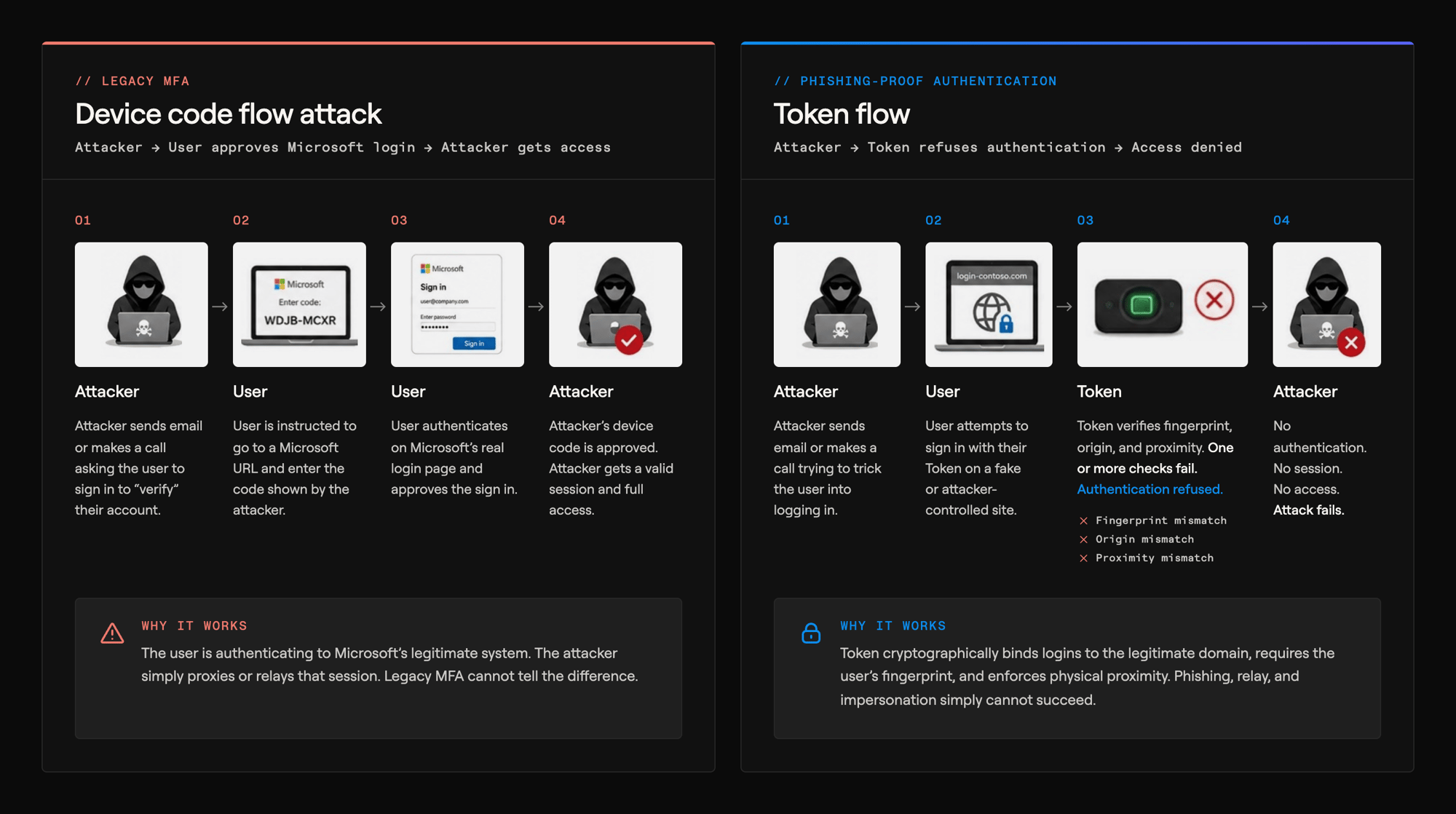
One example highlighted in the PCWorld article involves Microsoft 365 and the OAuth device code flow. This authentication method was originally designed for devices or applications that may not have a convenient browser or keyboard. Attackers have learned to abuse that legitimate workflow by persuading a victim to enter a code and authenticate through Microsoft’s real login infrastructure. The victim may never see an obviously fake Microsoft login page at all. Instead, the attacker is manipulating a genuine authentication process and convincing the employee to authorize access.
That distinction matters enormously. The attacker does not necessarily have to defeat Microsoft’s authentication system. The attacker only has to convince the legitimate user to complete the authentication process on the attacker’s behalf. Once again, the weak point is not necessarily the cryptography. It is the human decision sitting in the middle of the process.
This is the fundamental problem with much of legacy MFA. SMS codes, one time passwords, push notifications and authenticator apps were designed to add another hurdle after the password. They certainly improved security when they were introduced. But attackers adapted. Today, those authentication methods can be targeted through real time phishing, MFA fatigue, social engineering, help desk manipulation and increasingly sophisticated proxy attacks.
The common weakness is that the system can still ask the user to make an important security decision.
-
“Is this really you?”
-
“Do you want to approve this login?”
-
“Please enter this code.”
If an attacker can convincingly manipulate the user into answering correctly, the authentication system may happily let the attacker through.
Generative AI dramatically increases the attacker’s ability to do exactly that. Perfectly written phishing emails can be generated instantly. Highly convincing support messages can be personalized at scale. Fake websites can closely reproduce legitimate corporate login experiences. Voice cloning and other forms of AI assisted social engineering make the problem even worse. The result is uncomfortable but increasingly difficult to ignore. Training users to spot phishing cannot be the primary defense against phishing anymore.
We need authentication that assumes users will occasionally click the wrong link, believe a convincing message or respond to a sophisticated social engineering attempt. The authentication architecture itself has to prevent that mistake from becoming a breach.
That is exactly the problem Token was designed to solve. Token uses dedicated fingerprint based biometric hardware combined with FIDO2 cryptography and physical proximity. Instead of asking the employee to determine whether an authentication request looks legitimate, the system makes that determination cryptographically.
Each Token device stores its credentials in dedicated secure hardware. Authentication requires a fingerprint match directly on the Token device. The credential is cryptographically associated with the legitimate service for which it was registered, and the Token device must also be physically present near the system being accessed. This creates several independent barriers that an attacker cannot overcome simply by writing a better phishing email.
If an employee visits a spoofed website, there is no reusable authentication code to steal. If someone convinces the employee to reveal a password, the password alone does not provide access. If an attacker attempts to authenticate remotely, the dedicated Token hardware and the authorized fingerprint are not sitting next to the attacker’s computer. And unlike a push notification, there is no generic “approve” button that can be accepted simply because an attacker created a convincing story.
That is an important architectural difference. Token is not trying to make employees better at recognizing phishing. It is designed to make successful phishing irrelevant to authentication.
An employee can click the wrong link and the authentication layer can still protect the organization. An attacker can create a pixel perfect Microsoft message and still fail. Generative AI can make the phishing email indistinguishable from a legitimate one and it still does not provide the attacker with the fingerprint, dedicated hardware, cryptographic credential and physical presence required to authenticate. That is where enterprise identity security needs to go.
The cybersecurity industry has spent enormous sums of money detecting attackers after they enter the network. Endpoint detection, network monitoring, threat hunting and incident response are all important. But there is a much simpler question that deserves far more attention.
Why did the attacker get through the front door in the first place? Increasingly, attackers are not breaking through firewalls or exploiting exotic vulnerabilities. They are obtaining or manipulating legitimate authentication and then logging in as trusted users. That is why identity has become one of the most important security boundaries in the enterprise.
Our earlier analysis of AI enabled phishing reached the same conclusion. When attackers can create convincing spoofed experiences almost instantly, relying primarily on awareness training and legacy MFA becomes an increasingly fragile strategy.
The PCWorld article is another reminder that this transition is already happening. Phishing no longer has to look suspicious. In some attacks, the authentication experience itself can even be legitimate. The attacker simply manipulates the user into participating in the wrong authentication transaction. That means the solution cannot be another warning banner or another training module.
We have to remove the decision from the user. Authentication should prove that the correct person is physically present, using dedicated hardware, authenticating to the legitimate service through a cryptographically verified transaction. That is what Token provides.
AI may have made phishing almost impossible for humans to reliably recognize. Fortunately, we no longer need humans to recognize it. We can simply make it impossible for phishing to open the door.