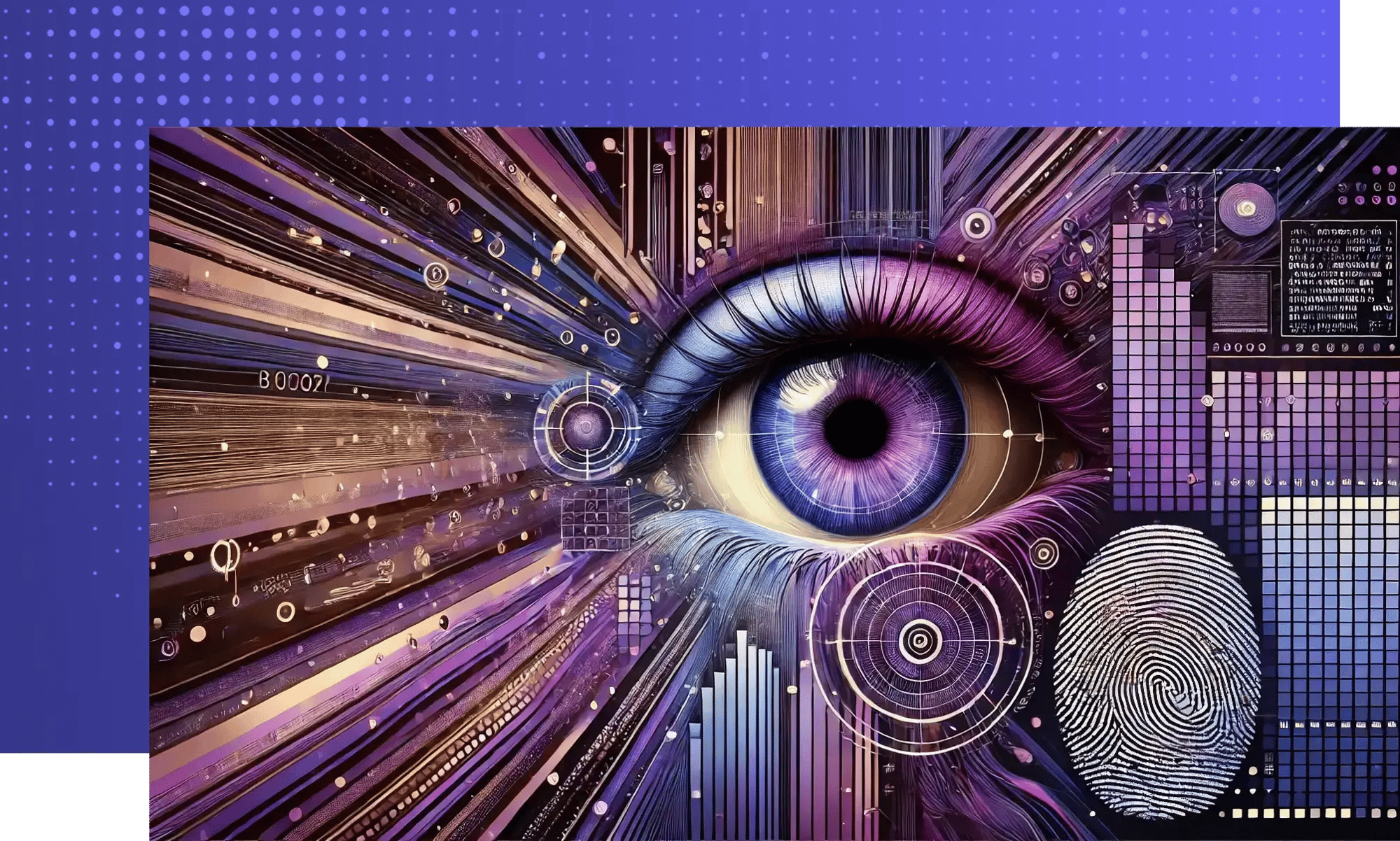
Biometric authentication replaces something you know or carry with something you are. A password can be guessed, stolen or shared. A fingerprint cannot. That distinction is what makes biometrics an attractive foundation for enterprise identity security.
But not all biometric methods are equivalent. Fingerprint recognition, facial recognition and iris scanning differ significantly in how they work, how they can be defeated and what they require to deploy at enterprise scale. Choosing between them is not choosing between equally secure options. It is making a tradeoff between convenience, cost, accuracy and attack surface.
This guide explains each method in terms relevant to enterprise deployment.
How Biometric Authentication Works
Biometric authentication verifies identity by comparing a live sample against a stored template. The process runs in three steps. Enrollment: the user registers their biometric trait and the system creates a mathematical template. Capture: at authentication time, the system takes a new sample. Comparison: the new sample is compared against the stored template, and access is granted if the two match within a defined tolerance threshold.
That threshold is the central tradeoff in biometric system design. A tighter threshold reduces false acceptances but increases false rejections. A looser threshold does the reverse. For enterprise deployments, false rejection rates have operational consequences.
A system that locks out five percent of users per day faces pressure to loosen its threshold or introduce bypass options, and bypass options are where most biometric deployments become exploitable.
Fingerprint Recognition
Fingerprint recognition maps the ridge patterns on a fingertip and converts them into a mathematical template. The template is stored. When the user authenticates, a new scan is compared against it.
For enterprise security, the most important design decision is where the template is stored. On-device storage, where the template never leaves the hardware token, means no central database exists for an attacker to target. Server-side storage centralises templates and means a single breach can expose biometric data for every enrolled user. Unlike a password, a fingerprint cannot be reset.
Fingerprint scanners are difficult to spoof under conditions that replicate real authentication. A lifted print from a surface can produce a usable replica in a lab. In practice, presentation attack detection in modern readers checks for pulse, temperature and electrical conductivity, raising the cost of a successful spoof significantly.
Facial Recognition
Facial recognition maps geometric relationships between facial features: the distance between eyes, the width of the nose, the depth of the jaw. It is highly convenient. No contact required, fast and naturally integrated into camera-based workflows.
For enterprise identity security, facial recognition carries a specific vulnerability. AI-generated deepfakes can produce face and voice replicas convincing enough to fool human observers and camera-based recognition systems. High-value fraud cases involving deepfake impersonation on video calls have been documented publicly. A facial recognition system without liveness detection is exploitable by a moderately resourced attacker.
Liveness detection partially addresses this. But the same AI capabilities that produce better deepfakes also get better at defeating liveness checks. Facial recognition is appropriate for low-to-medium assurance contexts. For high-assurance enterprise authentication, it should not be the sole factor.
Iris Scanning
The iris contains a complex, stable pattern unique to each individual. Unlike facial geometry, iris patterns do not change significantly with age and are not affected by facial hair, lighting or weight change in the same way. Iris scanning captures this pattern using near-infrared illumination and compares it against a stored template.
Iris scanning achieves very low false acceptance rates in controlled conditions. It requires the user to position their eye within the camera’s field of view, creating more friction than a fingerprint tap. For high-assurance environments such as server room access or financial authorisation, that friction is a reasonable tradeoff. For everyday enterprise login at scale, it is a barrier to adoption.
Iris patterns can be spoofed using high-resolution printed photographs in some scanner implementations. Iris scanners with active liveness detection are significantly more resistant to this.
On-Device Storage vs. Server-Side Storage
The most consequential security decision in any biometric deployment is where the biometric template lives.
Server-side storage centralises templates in a database. It simplifies cross-device authentication and management. It also means a breach of that database exposes biometric data for every enrolled user. Biometric data cannot be reissued. A user whose fingerprint template is stolen cannot enroll a new fingerprint.
On-device storage keeps the template within the hardware token. Authentication happens entirely on the device. No biometric data crosses a network and no central database exists for an attacker to target. The exposure of any one device affects only that device’s enrolled user.
For enterprise deployments handling sensitive data or privileged access, on-device storage is the correct choice. The management complexity it introduces is real. The security properties it provides are not available any other way.
What Happens When Biometric Data Is Compromised
A breached password can be changed. A breached fingerprint template cannot.
If an attacker obtains the mathematical representation of a user’s fingerprint from a server-side database, that fingerprint is permanently compromised as an authentication factor. There is no equivalent of a password reset. The biometric trait has become a known value in an attacker’s possession.
This is the argument for on-device storage. A system where biometric data never leaves the device means no central breach can compromise enrolled users at scale. The worst-case scenario is a single compromised device, not an entire enrolled population.
Template protection algorithms can reduce server-side risk by storing transformed representations rather than raw templates. Their effectiveness depends on implementation quality and whether the transformation can be reversed. They add complexity without eliminating the fundamental exposure.
Deploying Biometric Authentication in an Enterprise
Enterprise biometric deployment involves decisions that product documentation rarely covers.
Enrollment quality determines authentication reliability. A user who enrolls a fingerprint with a worn or wet fingertip will experience higher rejection rates. Enrollment protocols that capture multiple samples under controlled conditions, supported by IT, significantly improve day-to-day performance.
Exception handling matters as much as the authentication method itself. Users lose devices, injure fingers and age. The backup path that handles these cases is often the weakest link in the whole system. An enterprise deployment with a helpdesk bypass via email verification has traded a strong primary factor for a weaker fallback that an attacker will target.
Device compatibility and management tooling determine whether biometric authentication scales. Proprietary readers introduce procurement dependencies and single-vendor risk. Wearable authenticators with on-device storage that connect over standard protocols avoid both.
Multimodal Biometric Authentication
Multimodal biometric authentication combines more than one biometric factor.
Fingerprint combined with iris scan, for example. This approach reduces false acceptance rates and makes impersonation significantly harder, because the attacker must defeat two independent systems rather than one.
For high-assurance environments, multimodal authentication provides the strongest available biometric assurance level. The tradeoff is cost and user friction. Both factors increase with each additional biometric layer.
FAQ