The Red Queen Is Real: Identity Has Become the Only Perimeter That Matters

Attackers are accelerating. AI tooling has lowered the cost of sophisticated campaigns to near zero, while the scale of attacks has expanded across every phase of the attack chain — reconnaissance, initial access, lateral movement. The 2025 Tidal Cyber Threat Led Defense Report confirms what security leaders already understand: defenders no longer hold an inherent speed advantage.
This is the Red Queen dynamic. Running harder sustains position. It does not advance it.
But there is a more precise problem underneath the noise. Phishing and social engineering have changed structurally. Training-based defenses, however disciplined, are now insufficient by design. The architecture of the threat has shifted. The architecture of the response must follow.
What AI Has Removed
Generative AI has eliminated the observable friction that allowed humans to identify phishing attempts. Emails arrive with precise grammar, contextual detail, and accurate rendering of executive tone. Spoofed login pages are visually indistinguishable from the real thing. Clone sites are produced in seconds.
There is no longer a broken sentence to catch. No mismatched domain to flag. No formatting error to pause on. AI has not made phishing harder to detect. It has made detection an unreliable control.
When the authentication page is indistinguishable from the real portal, human judgment is not a last line of defense. It is a gap.
Training programs are built on the assumption that users can identify warning signs. That assumption no longer holds at scale. When phishing campaigns are personalized, contextually accurate, and visually perfect— and when a single user out of thousands needs only to be wrong once — the probabilistic math cannot be closed by awareness alone.
Identity Has Become the Primary Attack Surface
Modern breach patterns confirm the shift. Attackers are not exploiting unpatched servers. They are logging in through valid credentials. The front door, not the perimeter, is where access is obtained.
As AI improves software quality — reducing common coding errors and input validation flaws — the attack surface does not disappear. It concentrates. Code becomes more reliable. Identity becomes more exposed.
This is not a temporary condition. It is the direction of the threat landscape. Identity is the control that cannot fail.
The Authentication Gap
Even mature security programs face a structural gap. PAM solutions secure privileged credentials. Passkeys synchronize across cloud environments. USB security keys confirm device presence.
None of them prove that the authorized human is there.
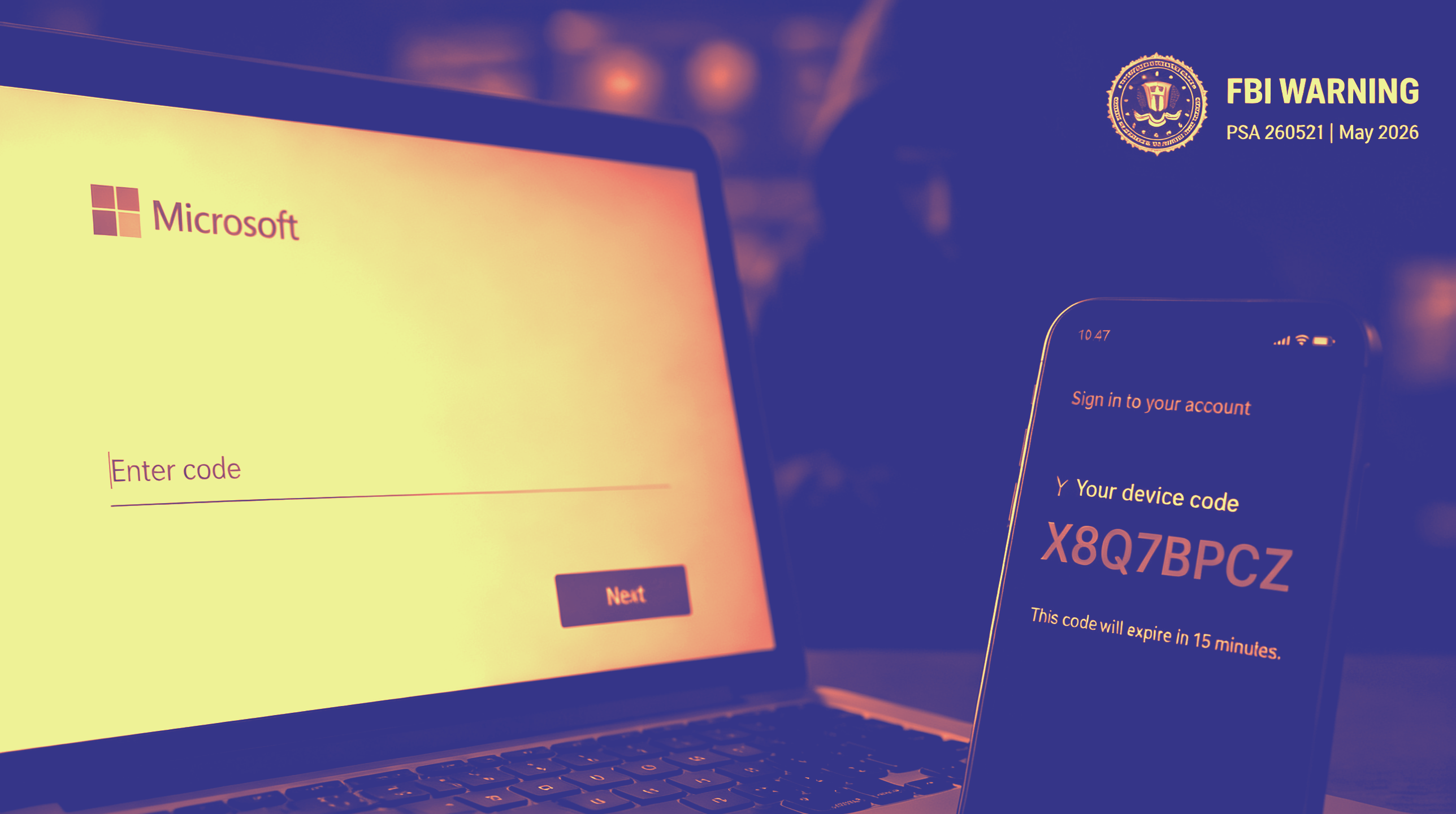
Push notification approvals can be coerced. One-time codes can be intercepted or entered on spoofed sites. A valid session, from the system's perspective, looks identical whether the right person authenticated or an attacker did. If an attacker can trigger an approval or capture a code, the authentication succeeds — and every control downstream treats the session as legitimate.
This is the authentication problem. AI has not created it, but AI has made it the dominant risk.
Cryptographic Identity Assurance
If the attack no longer depends on exploiting a user's judgment, the defense cannot either.
Token's Biometric Identity Assurance Platform removes the human decision from the authentication equation — not by restricting access, but by making the authentication itself proof of presence.
The system cryptographically verifies that a login request originates from the correct domain. It requires a live biometric match tied to a hardware-bound private key that never leaves the device. It enforces physical proximity — the authorized individual must be present, within range, at the moment of authentication.
There is nothing to relay. Nothing to intercept and replay. Nothing to approve remotely.
A user who clicks a malicious link, who believes a spoofed email is legitimate, who enters credentials into a convincing clone site — none of that creates access. The cryptographic origin does not match. The biometric requirement is not satisfied. Authentication fails. The session does not open.
Token verifies the human — not the device, not the credential, not the session.
AI can generate perfect phishing sites. It can craft convincing communications at unlimited scale. It can personalize social engineering with precision that exceeds what human attackers could achieve manually.
It cannot replicate a hardware-bound private key that never leaves a secure device, tied to a verified domain, unlocked only by a verified live biometric. That combination cannot be phished. It cannot be replayed. It cannot be delegated.
The Architectural Question
The Tidal Cyber report is correct that defense must become continuous and threat-led. Organizations should validate their controls against real-world tactics, not theoretical threat models. That discipline matters.
But continuous validation of controls that are structurally insufficient against the current threat does not close the gap. It measures it more accurately.
The underlying architecture must change. When AI makes phishing operationally perfect, training-dependent authentication is not a weak control — it is an absent one. The question is whether identity verification depends on a human correctly evaluating a threat, or whether it depends on cryptographic proof that cannot be deceived.
This Is Handled
For organizations operating in high-stakes environments — privileged access, sensitive infrastructure, regulated industries, national security — the margin for authentication failure is zero. A single compromised session is sufficient for breach, for data loss, for regulatory exposure.
Token's architecture was designed for exactly that condition. Not to reduce phishing risk. To make phishing irrelevant to the authentication outcome.
No phishing. No replay. No delegation. No exceptions.
.png)